|
The giant Zome model pictured here is a "truncated 120-cell."

click on the image to view a larger image
A 120-cell is a four dimensional polytope related to the dodecahedron. In the same way a polyhedron has polygon faces, a 4d polytope has polyhedra "hyperfaces" -- here, 120 dodecahedra. In the first week we made a projection ("shadow") of a 120-cell in just white & warm colors.

The new object is what happens when each of the 330 nodes is replaced by a tetrahedron. Shaving down a polyhedron node gives a new polygon face; truncating a polytope node gives a new polyhedron.
There are beautiful symmetries to be seen from various points of view: 2, 3, 4, 6-fold symmetries, 'tunnels,' and much more.
Construction notes: 1260 nodes, 780 B1 struts, 800 Y1, 480 R1, and 600 RO (projects like this prompted Zome to make these shorter reds). It helps to have a 120 cell as a guide (see the book Zome Geometry). Study the nodes from the center outward, which partitions them as 330 = 20 + 20 + 30 + 60 + 60 + 60 + 20 + 60. Each node will be replaced by one of eight types of tetrahedra, detailed in step #3 of Zome: Model of the Month - April 2007 (for a different project). Make the tetrahedra first -- this will use all the nodes, so that everything else is connecting these with struts. Conveniently, the tetrahedra types are numbered 1 through 8 corresponding to their order from center to boundary. Build from the inside out. We succeeded with only a few missteps; the wonderfully engineered Zome system forces many of the decisions.
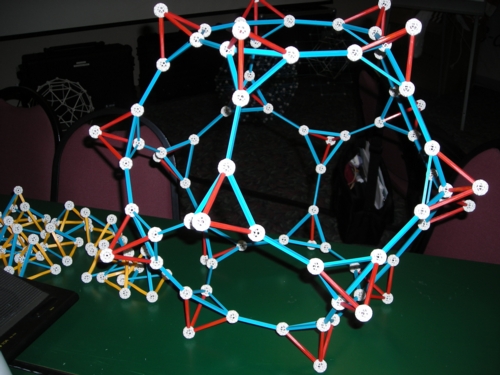
all the type 1 tetrahedra
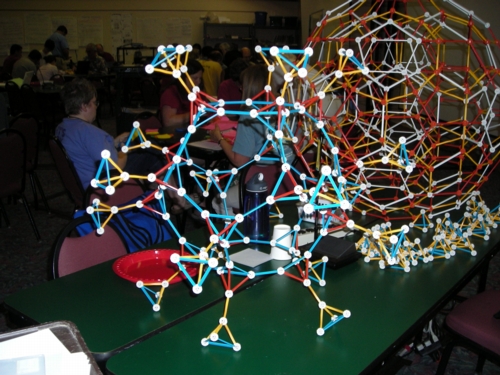
all type 1 & 2 tetrahedra

all type 1, 2, & 3 tetrahedra

all type 1, 2, 3, and 4 tetrahedra
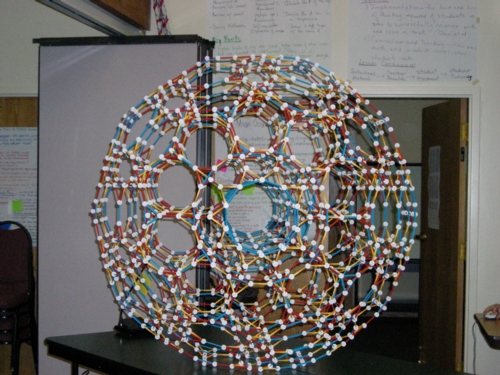
the completed object
|

